Voltage-sensor conformational microenvironments encode isoform-selective ion channel activation
Abstract
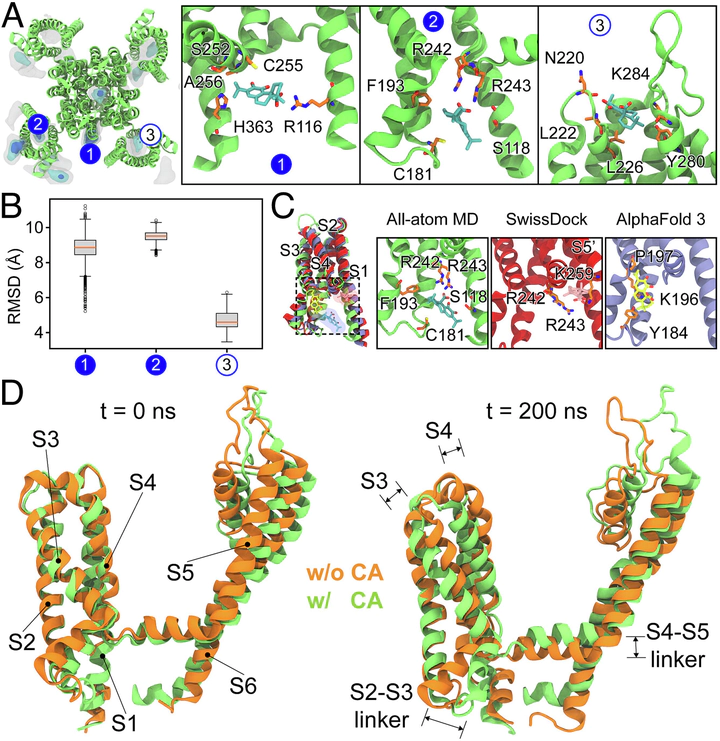
Isoform-selective opening of voltage-gated potassium (Kv) channels is desirable for its therapeutic potential yet mechanistically little-understood. Rosemary leaf metabolite carnosic acid (CA) is a high-efficacy opener of the neuronal Kv7.3 channel but exerts minimal effects on Kv7.2 or Kv7.2/3 heteromers. Here, using alanine-scanning mutagenesis, electrophysiology, radioligand binding, and all-atom molecular dynamics simulations, we found that CA achieves high-efficacy activation of Kv7.3 by binding at the extracellular cap of the voltage-sensing domain (VSD), independent of the canonical retigabine pore binding site. Kv7.3 samples a binding-competent VSD conformation absent in Kv7.2, characterized by an expanded extracellular pocket and a favorable electrostatic environment. Central to this mechanism, Kv7.3-L226 functions as a hydrophobic latch that tunes the energetic landscape of the voltage sensor to control ligand efficacy. Unexpectedly, CA potentiates Kv7.2/3 activation by retigabine via ligand-initiated positive allosteric coupling between the VSD and pore, thus enhancing the anticonvulsant action of retigabine despite CA lacking standalone anticonvulsant activity. The findings establish a mechanistic framework in which isoform selectivity arises from VSD conformational microenvironments rather than canonical binding determinants and highlight the voltage sensor as a tunable target for developing selective Kv channel openers.
Lorenzo Foglia
Ph.D. Student

Daniel Santos
Undergraduate Researcher

Alvin Yu
Assistant Professor of Physiology and Biophysics
My research interests include molecular biophysics, modeling and simulation, and statistical mechanics.